
In this episode
To the parent reading this at 9 PM, after a long day of work, dinner, homework, and putting kids to bed —
If your child has been quieter lately, more withdrawn, or struggling at school in ways that don't quite add up, you're not imagining it. And you're not alone.
Reaching out for support is never
Transcript
Picture this. It is 900 PM. The dinner dishes are, you know, finally scrubbed and put away, right? The house is actually quiet for once. Exactly. The homework is finished. The backpacks are zipped up and staged by the door for tomorrow morning. And you're just sitting there, maybe folding that last load of laundry or maybe just uh staring at the ceiling in the dark and suddenly it just hits you. That nagging heavy worry. Yes. That worry about your child creeps in. It's just an exhausting weight, isn't it? I mean, you spent all day holding it together, managing the endless logistics of modern life, and now in the stillness, you're left alone with this sinking feeling that
something just isn't quite right with your kid. It's a remarkably universal experience for parents. That specific time of night coupled with that um that specific flavor of worry. It's a phenomenon we see documented constantly in clinical settings, which is exactly what we are focusing on today. For this deep dive, we are pulling from a really compelling stack of clinical data and research. Specifically, we've got materials from Mental Space School, right? The organization focusing on K through2 student wellness down in Georgia. Yeah, them. We're looking at their robust outcome data on taotherapy models and combining that with some truly eyeopening developmental research on well the mechanics of parental intuition. And the goal here is highly specific.
We're going to look closely at the underlying mechanisms of that late night anxiety because understanding the why changes entirely how we respond to it. Totally. Our mission for this deep dive is to prove to you the parent lying awake right now staring at the shadows on the ceiling that your 900 p.m. worry isn't just some irrational free floating anxiety. No, it's highly accurate vital data. Exactly. And more than that, we're going to map out the exact practical steps you can take tomorrow morning to find clarity without overwhelming your family or, you know, your finances. So, to really understand the validity of this feeling, we have to examine why it strikes so reliably at 9:00 p.m.
because it is absolutely not a coincidence. Okay, let's unpack this. Why 9:00 p.m. specifically? Well, the clinical research points to what we can essentially categorize as a biological masking effect. During the day, your body is essentially in a mild state of fight or flight, like just from normal daily stress. Exactly. You're navigating traffic. You're managing work deadlines, breaking up sibling arguments. Your cortisol and adrenaline levels are elevated just enough to keep you focused on immediate external tasks. Right. So, you're saying our bodies are literally suppressing our ability to process complex emotional information during the day because we are just like too busy trying to survive the schedule. That's the exact mechanism at play. Your brain
prioritizes the immediate threat, like making sure nobody misses the school bus. But at 9:00 p.m., those daytime distractions just evaporate because you aren't working and you aren't actively managing the kids, right? As your body prepares for sleep, that taskoriented cortisol finally drops. And when that chemical noise clears, the subtle lower frequency emotional data your brain has been collecting all day about your child finally has the space to surface. Wow. So the quiet doesn't create the worry. It simply unmasks the data you've been subconsciously gathering all day. Precisely. That makes so much sense. But it also I mean it feeds directly into this incredibly common myth we tell ourselves. Yeah. Because it hits us when we're
tired and alone in the dark. The myth is, well, if something were really wrong with my kid, I'd know for sure during the light of day. Right. The classic, this is probably nothing. It will pass rationalization. Yeah, we try to rationalize it away because the late night timing makes it feel spooky or irrational. We dismiss it as a byproduct of our own fatigue, but the developmental psychology research we're examining completely shatters that assumption. The reality is that this late night intuition is tracking legitimate subtle shifts in a child's baseline behavior. And the tracking data on this is wild, right? It really is. The data shows that parents naturally detect behavioral changes in their children 2
to four weeks before teachers do. Wait, two to four weeks before teachers. The people who literally have degrees in child development and spend 7 hours a day with them. Yes, but consider the environment. A teacher is monitoring a classroom of 30 students. Their threshold for noticing a behavioral change is often tied to disruption. Ah so if a child suddenly becomes loud or aggressive or fails to turn in assignments, a teacher spots it immediately. Exactly. But if a child is slowly retreating inward, quietly disengaging or masking their anxiety by being a quote unquote perfect quiet student, it just doesn't trigger the teacher's radar. But a parent knows the child's intimate baseline, right? you know exactly how
much they usually talk at dinner or the specific way they usually react to a joke. It's the micro expressions in the rhythms of the house. And the research says it's even more pronounced when you compare parents to doctors. Right. Well, if the timeline expands significantly, parents detect these changes an astounding 4 to 6 weeks before pediatricians notice anything. Four to 6 weeks. Because a pediatrician sees your child for maybe 15 minutes during an annual checkup, your parental intuition is finally tuned to a degree that external professionals simply cannot match in the early stages of a struggle. That is just wild. It makes me think of an analogy like think of a check engine light in
your car. Oh, I like that. Right. When you're driving down the interstate during the day, the radio is blasting, traffic is merging, you're laser focused on not missing your exit. You might not even notice that little yellow light glowing on the dashboard. You're too busy operating the vehicle. Exactly. But then you pull off the highway, you're sitting idling at a quiet stoplight at night. Suddenly, that check engine light is glaringly obvious. It feels like the only thing you can look at because the light was always there providing real mechanical data about the engine, right? But you needed the physical stillness to actually process what it was telling you. And treating that late night feeling as
a dashboard indicator as raw data is the crucial first step here. But I have to push back on this a little bit because I think a lot of parents listening might hear this and think, come on, I'm just projecting. It's a fair concern because when we are exhausted, everything looks like a crisis. How does a parent actually know that we aren't just projecting our own adult burnout onto our kids? I mean, isn't there a massive risk of confirmation bias? What's fascinating here is that the clinical data actually differentiates between parental projection and intuitive data gathering. Oh, really? How do they tell the difference? Well, when parents project their own stress, it tends to manifest as
a broad generalized anxiety about the future, like worrying about college admissions when the child is in fourth grade, for example. Okay, that tracks. But the 9pm phenomenon we're discussing is almost always anchored to specific present tense behavioral shifts. You aren't worrying about 10 years from now. You're worrying because your child suddenly stopped wanting to play with their best friend this week. Or their sleep patterns have dramatically fractured over the last 10 days. Exactly. That specificity is the hallmark of actionable data, not stress projection. Which brings us to a massive, slightly terrifying piece of this puzzle. Because if we accept the premise that this intuition is accurate data, we are forced to look at the consequences
of ignoring it. The cost of waiting. Yeah. What actually happens in the brain of a child when we just roll over, go to sleep, and hope it's better in the morning. The developmental research outlines what is termed the early intervention math. And the mechanics of it are quite stark. The data shows that for every single week a psychological or emotional issue goes unressed, it requires roughly 2 weeks of recovery time. Okay, let's unpack this. One week of waiting equals 2 weeks of recovery. Why is the ratio so heavily skewed against us? It comes down to no plasticity and the development of maladaptive coping mechanisms. Let's say a child develops a sudden intense anxiety about attending
school. Okay, if that goes unressed for a week, the child's brain doesn't just sit in a neutral state of anxiety. The brain actively attempts to solve the pain. So, they start changing their behavior, right? The child might start withdrawing from friends or acting out aggressively at home to brain off the nervous energy or even developing psychosmatic stomach aches to avoid the bus. Oh, wow. So, by the time you intervene a month later, you aren't just dealing with the original school anxiety anymore. Exactly. You now have to unspool the social withdrawal, the behavioral acting out, and the physical symptoms. The longer you wait, the more complex the root system of the problem becomes. The weeds just
spread, and the signs parents are picking up on at 9:00 p.m. are the earliest sprouts of those weeds. Things like subtle withdrawal, sudden unexplainable mood shifts, school refusal, disruptions in sleep, or changes in their peer group. I really want to validate any parent listening right now who has noticed these exact things but has been talked down by well-meaning friends or family who say, "Oh, it's just a phase. They'll grow out of it." The they'll grow out of it advice is incredibly common, and it is entirely rooted in a societal misunderstanding of that early intervention math we just discussed. Because hoping a child will simply outgrow a behavioral shift is like hoping a car will outgrow
a rattling transmission. It fundamentally ignores the compounding nature of the problem. And this naturally leads us to one of the most difficult dynamics in any household. Partner friction. Oh yeah. What happens when one parent feels that 900 p.m. intuition deeply? And the other parent looks at the same kid and says, "I think you're overreacting. Let's just wait and see." It's the ultimate standoff. And the materials we reviewed mentioned that in those moments when a partner is firmly in the let's wait camp, there are honest questions you can ask to shift the conversation away from an argument. But let me ask you a very practical realworld question here. If one parent desperately wants to intervene and
the other is firmly resistant, doesn't pushing the issue risk creating a massive household shaking conflict? That's the fear. Certainly. Aren't you risking blowing up your marriage over something that might be minor? Isn't it sometimes safer for the family unit to just wait it out? If we connect this to the bigger picture, we have to look at the timeline of that household stress. Waiting might absolutely avoid an argument tonight in the kitchen, right? But remember, the 1:2 recovery ratio as the child's unadressed struggle deepens. Their behavior will inevitably become more disruptive. So the conflict you avoid today just morphs into a much bigger crisis later. Exactly. Yeah. a structurally damaging family crisis 6 months from now
when the child hits a breaking point. The key to avoiding household conflict isn't to wait in silence. The key is to completely change how you take the first step because the friction usually happens because parents assume the first step has to be this massive dramatic intervention. Precisely. And this is exactly where the mental space school model introduces what I honestly think is a secret weapon for parents because changing how you take the first step is entirely about framing. The clinical guidance provides the exact scripts and strategies to take action without causing a panic attack in your spouse or your child. There is a specific highly effective script that completely bypasses the usual resistance yet nobody
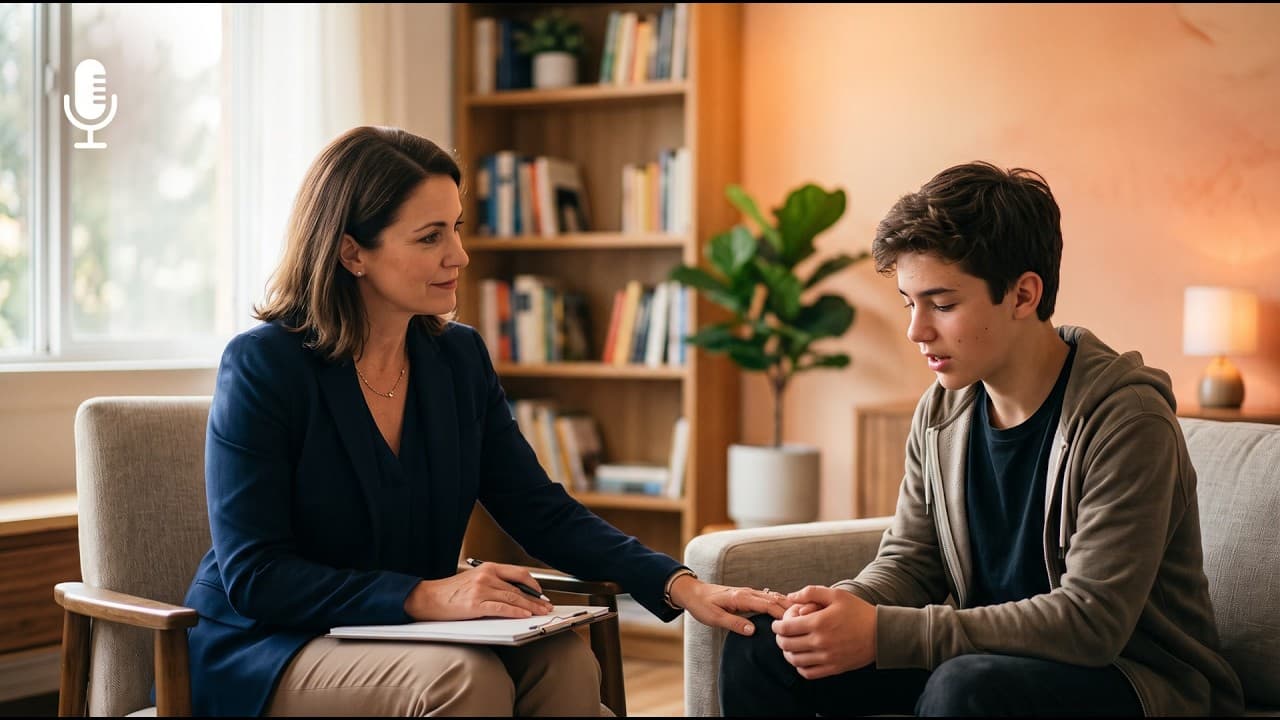
really teaches it to parents. What's the script? It's simply this. I want to talk to someone for myself first. I want to talk to someone for myself first. I love that. It immediately lowers the temperature in the room. It introduces the concept of the parent first intake call. You are doing this before you ever involve the child and often before you even need full buyin from a hesitant partner. So, you make a call to a professional to get a plan, to map out the terrain, and to gain clarity just for your own peace of mind. Exactly. It's like a scouting mission for a family vacation. A scouting mission is the perfect framework, right? You don't
just pack the kids into the minivan, throw away the map, and drive into the deep wilderness hoping you randomly stumble across a safe campsite. That's a recipe for a meltdown. You look at the topography first. Yes. You survey the terrain, you find the safe paths, you figure out where the dangerous drop offs are, and you map the logistics. Then, once you know the exact route, you bring the kids along. What this entails is a 20 to 30 minute first call with a licensed therapist. What the clinical data emphasizes about this parent first approach is that there is zero commitment. There is absolutely no diagnosis given to your child and there is no pressure to immediately
start a massive treatment plan. It is purely an information gathering expedition. Right? This approach empowers the parent immensely because it validates your data, but it completely removes the pressure from the child. The child doesn't even need to know the call is happening. And when you are finally ready to bring the child into the fold after you've done your scouting, the guidance gives you the exact script to use so you don't terrify them. Because you definitely don't sit a 9-year-old down and say, "We think there's a problem with your brain. We are taking you to a doctor." No. The script they recommend is, "We're going to talk to someone who's really good at helping kids your
age figure stuff out like a coach." but for feelings. Like a coach but for feelings. Consider why that phrasing works so beautifully. It normalizes the experience by anchoring it to something the child already understands and respects. Exactly. A sports coach doesn't mean you are broken. A sports coach means you are learning new skills to perform better. It completely removes the clinical stigma and frames the mental health professional as an ally. Okay, so let's look at where we are. We've got the scientific validation that the 900 p.m. worry is real biological data. We understand the terrifying neuroplastic math of why we can't afford to wait. We have the low pressure scouting mission strategy. And we have
the exact scripts to use with our partner and our kid. But now we have to talk about the final and often most insurmountable roadblock, the real world. Ah yes, the systemic barriers to entry. finding the time, finding the money, and finding the right professional to actually execute this plan. This is where the theoretical meets the practical, and it is where the specific operational model from Mental Space School becomes highly relevant. Their program is designed specifically for Georgia K through 12 students. But more critically, the architecture of their program is built around the logistical reality of that exhausted parent awake at 9:00 p.m. Here's where it gets really interesting. Because the way they have structured this
completely dismantles the traditional, frankly, broken mental health access model. Let's talk about the sheer logistics of time first. They offer sameday teleaotherapy appointments for Georgia families and the mechanism of same day access is virtually unheard of in traditional community care models. Usually, when a parent finally works up the courage to make that scouting call, they are hit with a 3 to sixmonth wait list, which if we apply the early intervention math, means a minor issue has compounded into a major crisis by the time the first appointment arrives. You're multiplying that 1 to two week ratio out for months. Exactly. But with Mental Space School, they have evening and weekend slots explicitly designed so working parents
can actually attend these virtual sessions with their child without having to burn through their limited paid time off or risk their jobs. And because it's taotherapy, it's happening right from your living room. They also prioritize a deeply diverse and culturally competent team of licensed therapists. The multilingual availability here is huge. Spanish is available as a primary immediate option and they have Vietnamese, Korean, Mandarin, and Arabic available on request. That linguistic access is vital. Oh, totally. Navigating the emotional nuances of a parent intake call is difficult enough in your native tongue. Trying to articulate subtle shifts in your child's baseline behavior through a language barrier adds an incredibly discouraging layer of friction to the care process.
Yeah, I can't even imagine. Furthermore, by providing dedicated therapist teams assigned to specific schools and offering family sessions alongside parent coaching, they are creating a comprehensive localized support web rather than just an isolated clinical visit. Right. And let's talk about the absolute biggest barrier of all, the financial wall. Yes. Because usually in the American health care system, when you hear the phrases same day access and specialists, your wallet instinctively tries to hide. Very true. But Mental Space School has engineered this to actively relieve financial panic. For Georgia Medicaid families, it is 0 out of pocket. No hidden fees. Zero. And for families utilizing commercial insurance, the model is equally proactive. They are in network with
all the major commercial providers across the state like BCBS, Sigma, Etna, UHC, Humanana, Peach State. Caresource AR groupoup. The operational design ensures that care is covered with typical predictable low co-pays and absolutely no surprise billing months down the line. They've even built sibling discounts into the model, recognizing that family dynamics often require each child to have their own therapist. All of which is coordinated through that same dedicated care team. It's just incredibly rare to see sameday access specialist and zero dollars for Medicaid functioning in the same ecosystem. But there is one more massive worry parents have, especially when a program is affiliated with their child's school, and that is privacy. Oh, confidentiality is always a
primary concern. For anyone not deep in state legislation, there is a mandate called the HB268 Georgia school mental health law, which has a compliance deadline coming up in July 2026. Right? It basically pushes schools to formulate policies around mental health interventions. But the sticking point for parents is always, well, if the school is involved, is my kid's anxiety suddenly part of their permanent academic record? Is the principal going to know all my family's business? The clinical guidelines address this privacy concern unequivocally. The entire mental space program operates under strict APA and FKA compliance. So, the mechanism of privacy is absolute. Yes, school administrators and teachers do not have access to individual family usage data or
clinical notes. Okay, that's huge. The school knows the program exists and utilizes it to meet their HB268 legal mandates, but the specific details of your child's therapy remain locked safely between your family and the licensed professional. It solves the structural legal needs of the school district while fiercely protecting the confidentiality of the individual family unit. And we have the hard data to prove that this accessible, highly protected model actually works in the real world. The clinical outcomes reported by mental space are staggering when you think about the human relief behind the numbers. What are the exact figures there? An 89% improvement in student attendance, a 92% reduction in reported anxiety symptoms, and an 85% overall
family satisfaction rate. If we look at the mechanics behind those numbers, they represent a fundamental paradigm shift. By systematically dismantling the logistical, financial, and access barriers, Mental Space School transforms mental health care from a delayed, frantic crisis response into a proactive, highly accessible everyday tool. So, what does this all mean? Let's trace the journey we've just taken together. We started in that quiet, heavy, isolated moment at 9:00 p.m. We uncovered the biological truth that the check engine light going off in your head isn't anxiety. No, it is real, accurate data based on subtle baseline changes you are noticing weeks before the professionals do. And we looked at the terrifying compounding math of early intervention where
every single week you wait to act ends up costing your child two weeks of difficult recovery. But then we map the path forward, right? You don't have to blow up your life. You execute a low pressure scouting mission. You use the script, I want to talk to someone for myself first. and you do a 20inut zero pressure parent intake call to get your bearings. And finally, you utilize an accessible sameday taotherapy model that completely removes the financial nightmares and scheduling impossibilities that usually block families from getting help. When you lay the mechanics out like that, the path from late night worry to actionable clarity is actually remarkably short. It really is. So to you, the
exhausted parent lying in bed or sitting in the quiet of your kitchen listening to this right now, we see you. The heavy weight you're carrying is valid. It's mathematically real and most importantly, it is entirely solvable. You don't have to wait until tomorrow and you don't have to wait for the problem to get worse to justify taking action. You can go to mental spacechool.com or reach out directly to mental spacechool at chicherapy.com right now to set up that simple scouting mission. This raises an important question though as we wrap up our analysis of this developmental research. Oh, what's that? Well, if our parental brains are so incredibly finely tuned that they can organically detect subtle
microscopic shifts in our children weeks before highly trained professionals do, what other subtle crucial data points in our family's daily rhythms are we tuning out simply because we mistakenly write them off as our own exhaustion?
More episodes

How to manage ADHD in a 3 year old? — Full Episode
How to manage ADHD in a 3 year old?
How to help a teen with severe depression? — Full Episode
How to help a teen with severe depression?

When a Teen Becomes the Parent: Sibling Care and School
Educators and parents: some of the most responsible kids in your building are also the most tired.
Need this kind of support in your school?
MentalSpace School delivers teletherapy, onsite clinicians, live workshops, and HB-268 compliance support to K-12 districts nationwide. Book a 15-minute call to see what fits.
Get started